Heads up: Plant care apps give general guidance. Identification and diagnosis can be wrong. If a pet or child may have eaten a plant, call your vet, doctor or poison control right away.
The 5 Best Plant Care Apps in 2026: We Ran Each One on a Real Windowsill Jungle
Most houseplants that die indoors are drowned, starved of light or simply forgotten. Some apps identify your plant and stop there; others give you a schedule you'll actually follow. We compared the most popular plant care apps on what keeps plants going week after week: the right care, on the right day, for the spot each plant actually lives in.
STBy The shavethat.com Review Desk · Updated November 9, 2026 · 16 min read
Advertising disclosure: we have a business relationship with LeafBell, our #1 pick, and earn money when readers sign up. How this page works.
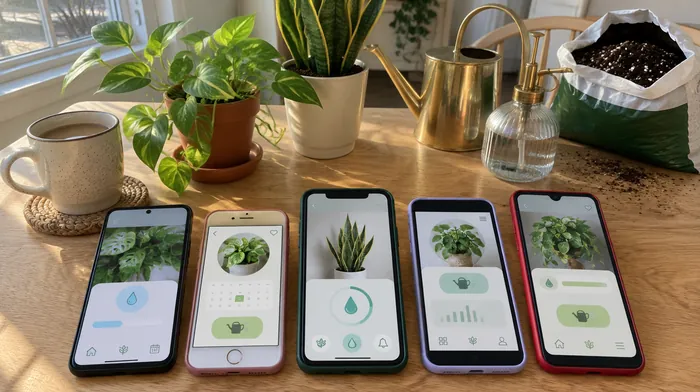
Five phones, five plant care apps, one very thirsty kitchen table.
Plant care apps come in three flavors: ones that tell you what a plant is, ones that hand you a care encyclopedia, and ones that turn all that into a schedule and remind you when something is due. We used five of the most popular plant care apps on a mixed collection of common houseplants to see which one actually makes day-to-day care easier, and one clearly stood out.
Quick picks: the best plant care apps
LeafBell — best plant care app overall (light-adjusted water & feed schedule + daily reminders)
Planta — best for detailed care tracking
PictureThis — best for identifying almost anything
Greg — best for watering amounts and community help
Blossom — best for care guides and edible plants
How we tested
We set up each app with the same group of common houseplants (a pothos, a snake plant, a monstera, a calathea, a fiddle leaf fig and a few succulents) spread across bright, medium and low-light spots, and scored six things: how well it identifies a plant, how specific its care schedule is, whether it accounts for light, how reliably it reminds you, how useful its help is when something goes wrong, and how much it costs to get the features that matter. We also read each app's store listing and description.
The criterion we weighted most heavily: does the app turn "what is this plant?" into a simple, specific schedule for the spot it lives in, and then reliably tell you when something is due? Knowing a plant's name doesn't water it. The best plant care app is the one that tells you exactly what to do today, for each plant, and makes it easy to tick it off.
Editor's Choice
1
LeafBell
Best plant care app overall
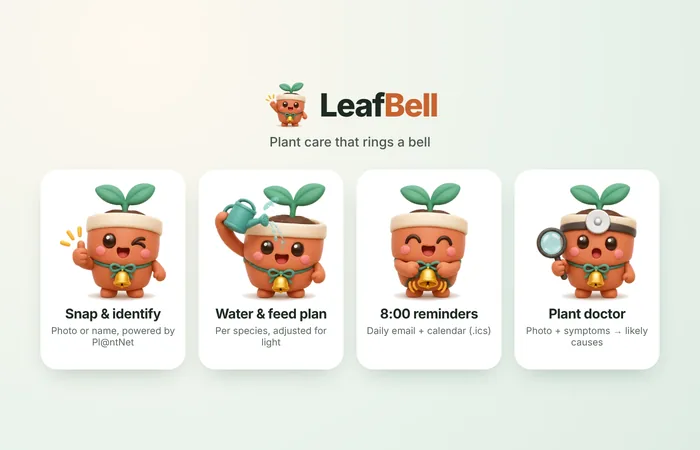
LeafBell starts with a 60-second quiz, then lets you snap a plant or simply type its name. It identifies the species (identification is powered by Pl@ntNet) and builds a watering and feeding schedule for that species, adjusted for the light in its spot: low, medium or bright. Every morning a "Today" list shows which plants are due for water or food, with one-tap done, undo and snooze. You get a daily reminder email at 8:00 local time, and you can add calendar reminders (.ics) for each plant. When a plant looks off, the photo plant doctor takes a picture plus the symptoms you tick and suggests likely causes and step-by-step fixes; the answers are AI-generated and LeafBell itself calls them "a guide, not a guarantee." Care guides include pet-safety notes, and the 48-lesson Plant Parent Academy adds XP, streaks and 12 medals, cheered on by Bella, a terracotta pot with a sprout and a little bell. That combination, a specific, light-aware schedule plus a daily nudge, is exactly what our most-weighted criterion rewards.
Pros
Schedule per species, adjusted for low, medium or bright light
"Today" list with one-tap done, undo and snooze
Daily 8:00 reminder email plus per-plant calendar (.ics) reminders
Photo plant doctor with step-by-step fixes, and pet-safety notes in care guides
48-lesson Academy with XP, streaks and medals; 30-day money-back guarantee
Cons
Runs in your phone's browser (add it to your home screen), not an App Store download
No native push notifications; reminders come by email and calendar
Newer than the big names, so few public reviews so far
Planta is one of the best-known plant care apps, rated 4.8 on the US App Store from 114,000+ ratings (checked November 2026). It identifies plants from a photo and builds schedules for watering, fertilizing, repotting, pruning, misting and more, with reminders it says adapt to your home environment, local weather and plant type. It also has a built-in light meter, a "Dr. Planta" symptom checker, a care journal and the option to share care with family while you're away. It's a polished, very complete app; the most useful features sit behind its Premium subscription, and the sheer number of task types can feel like a lot if you just want to keep a few plants alive.
Pros
Very detailed schedules beyond watering
Light meter and Dr. Planta symptom checker
Share care tasks with others
Cons
Key features need a Premium subscription
Can feel busy for a small collection
3
PictureThis
Best for identifying almost anything
PictureThis is the giant of plant identification, rated 4.8 on the US App Store from 1.1 million+ ratings (checked November 2026). Its listing says it can identify over 400,000 species, and it adds photo disease diagnosis, care tips with watering and fertilizing reminders, toxic-plant warnings for pets and kids, a light meter, weed ID and expert chat. If you want to know what's growing on your walk or in your garden, it's superb. As a day-to-day houseplant scheduler it's good rather than focused: identification is the star, and the full feature set is part of PictureThis Premium.
Pros
Huge species coverage and a massive review base
Disease diagnosis and toxic-plant warnings
Great outdoors and in the garden too
Cons
Identification-first; scheduling is secondary
Many features need a Premium subscription
4
Greg
Best for watering amounts and community help
Greg (4.6 on the US App Store from 20,000+ ratings, checked November 2026) focuses on watering. Its free scan identifies a plant, and Greg says it can estimate the pot size and distance to the nearest window, then build a watering plan from the plant's species, size and your home's conditions, including how much water to give. A friendly community helps with troubleshooting. Precision watering, smart reminders, an indoor light gauge and seasonal updates are part of its subscription, listed at $29.99 a year in the US with a 7-day trial. It's excellent for watering; fertilizing guidance and problem-solving lean more on the community.
Pros
Tells you how much water, not just when
Free plant scan
Active, friendly community
Cons
Watering is the main focus
Troubleshooting relies largely on other users
5
Blossom
Best for care guides and edible plants
Blossom (4.6 on the US App Store from 68,000+ ratings, checked November 2026) combines photo identification of more than 30,000 plants with care reminders for watering, fertilizing and repotting, a water calculator based on plant type and pot size, plant disease ID, an "AI Botanist," weather alerts, a planting calendar for edible plants and a plant-care blog. It's a great reference library for learning; unlimited identification, diagnosis, water calculations and reminders are Premium features.
Pros
Rich care guides and articles
Water calculator and weather alerts
Planting calendar for edible plants
Cons
Unlimited reminders and IDs need Premium
More of a library than a daily plan
At a glance
Plant care apps compared
App
Care schedule
Light-aware
Reminders
Problem help
Platform · rating
LeafBell
Water + feed, per species
Yes: low / medium / bright
8:00 email + calendar (.ics)
Photo + symptoms plant doctor
Browser · iPhone & Android
Planta
Water, feed, repot, prune, mist
Yes, plus light meter
App notifications
Dr. Planta
iOS / Android · 4.8★ (114k+)
PictureThis
Water + feed tips and reminders
Light meter
App notifications
Photo diagnosis, expert chat
iOS / Android · 4.8★ (1.1M+)
Greg
Watering plan with amounts
Light gauge, window distance
App notifications
Community
iOS / Android · 4.6★ (20k+)
Blossom
Water, feed, repot reminders
Light needs in guides
App notifications
Disease ID, AI Botanist
iOS / Android · 4.6★ (68k+)
Based on our hands-on use and each app's public store listing, checked November 2026 (ratings from the US App Store). Many features are part of paid subscriptions. Features and prices change, so check each app before you choose.
Part 1
Why a plant care app helps (when it's the right kind)
Most houseplant trouble isn't about having a "black thumb." It's about guesswork and memory. Every plant has different needs, the same plant needs different care in a bright window than in a dim hallway, and the right day to water is easy to forget when it comes around once every week or two. A good app takes the guessing and the remembering off your plate.
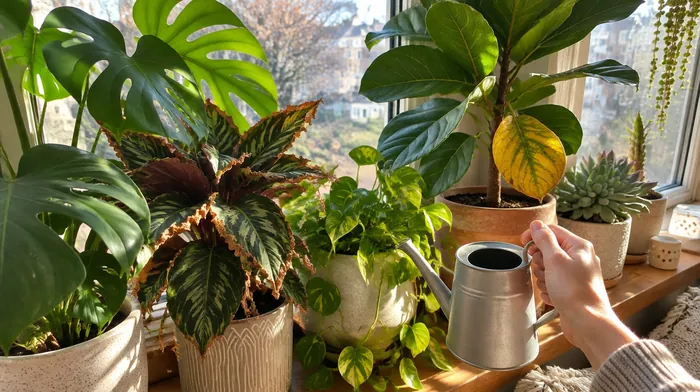
Six plants, six different needs, one watering can.
1. Every species is different
A snake plant is happy drying out for weeks; a calathea sulks if it does. Treating every pot the same is the fastest way to lose some of them. An app that knows the species can give each plant its own rhythm.
2. Light changes everything
The same pothos drinks far more in a sunny window than in a low-light corner, where soil stays wet longer. Watering "every Sunday" without considering light is how many indoor plants end up overwatered. A schedule that accounts for the light in each spot is much closer to what the plant actually needs.
3. Overwatering is easy to do
Many houseplant problems, from yellowing leaves to soggy soil, come from loving a plant a little too much with the watering can. A clear schedule helps you water when it's due, not whenever you walk past.
4. Feeding is the step everyone forgets
Plants in pots slowly use up the nutrients in their soil. Feeding during the growing season is easy to skip because it happens so rarely. Reminders make it part of the routine.
5. Problems are easier to fix early
Drooping, brown tips or spots are often fixable if you catch them early and change the right thing. A plant doctor that points you to likely causes helps you act sooner instead of guessing.
6. It turns care into a habit
A short daily check-in, a list of what's due and a little satisfaction from ticking things off turn plant care from a worry into a two-minute routine.
Part 2
The problem with most plant care apps
Every app on our list can tell you something useful about your plants. The difference is what happens after that. Here's where most fall short in day-to-day use:
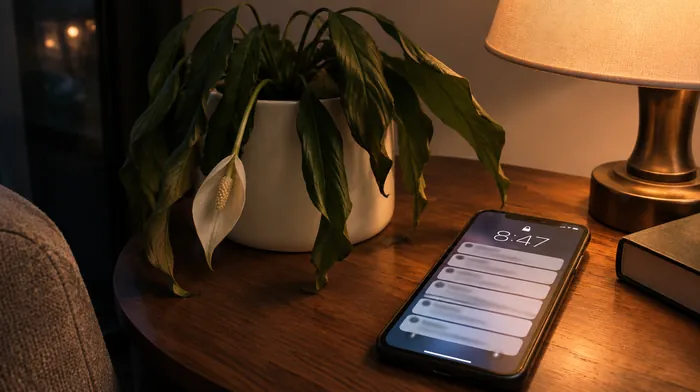
A dozen notifications later, the peace lily is still thirsty.
01
Identification without a plan
Knowing your plant is a "Ficus lyrata" is satisfying. But the question that matters is "what should I do for it this week?", and many apps leave that part vague.
02
One schedule for every spot
Generic "water weekly" advice ignores whether the plant sits in a bright window or a dim corner, which is exactly where overwatering starts.
03
Notification fatigue
Lots of pings for lots of task types are easy to swipe away. After a few weeks, many people stop reading them, and the plants go back to being forgotten.
04
Feeding gets left out
Some apps are built mostly around watering. Fertilizing quietly drops off the radar, and plants slowly run out of steam.
05
A library instead of a routine
Thousands of articles are great to browse, but they don't tell you which three plants need you this morning.
GIFIllustration: only the plants that are due light up, and each gets a check mark once it's done.
That's the idea behind LeafBell: a water and feed schedule for each plant, adjusted for the light where it lives, and one simple "Today" list that shows only what's due. One email at 8:00 in the morning, a calendar reminder if you want one, and a tap to mark it done, undo it or snooze it. It's the main reason it ranks #1 here.
Part 3
What happens without a plan: four everyday examples
Please note: these are illustrative examples, composites of situations plant owners commonly describe. The people and names are invented. They are not testimonials or endorsements, and they don't describe typical results.
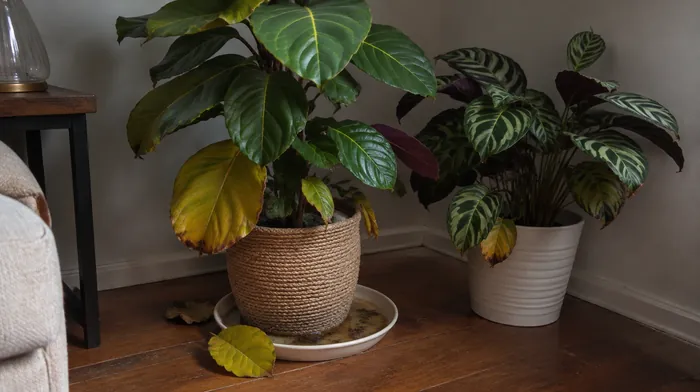
Dim corner, soggy saucer, falling leaves: a very common combination.
Example A · "Sofia"
The Sunday waterer
Situation: Sofia waters all of her plants every Sunday, the same amount, whether they sit in the bright kitchen window or the darker bedroom.
What went wrong: the window plants were often thirsty by Thursday, while the bedroom plants never dried out and started yellowing.
What a plan changes: a separate rhythm for each plant based on its species and the light in its spot, so each gets watered when it's actually due.
Example B · "Marcus"
The forgotten fertilizer
Situation: Marcus bought a bottle of plant food in spring with the best of intentions.
What went wrong: it's still almost full in autumn. Feeding happens so rarely that it never became a habit.
What a plan changes: feeding shows up on the same "Today" list as watering, on the right days, with a one-tap done.
Example C · "Priya"
The worried guesser
Situation: Priya's monstera developed brown, crispy edges, and she found ten different explanations online.
What went wrong: she changed three things at once (more water, a new spot and repotting), and couldn't tell what helped or hurt.
What a plan changes: a photo plus the symptoms she's seeing, a short list of likely causes, and step-by-step fixes to try one at a time.
Example D · "Tom"
The swiped-away reminder
Situation: Tom set up a plant app with reminders for every possible task.
What went wrong: his phone buzzed so often that he started swiping them all away, including the ones that mattered.
What a plan changes: one morning email listing only what's due today, plus calendar reminders for the plants he cares most about.
Part 4
When to start using a plant care app
The best time is before a plant starts struggling, but it's never too late to give one a better routine. These moments matter most:
When you bring a new plant home. Setting up its care on day one is easier than rescuing it later.
When your collection grows past a few pots. Three plants fit in your head; ten different schedules don't.
When you move a plant. A new spot means new light, and new light means a different watering rhythm.
When the seasons change. Shorter, darker days slow many plants down, and spring growth makes feeding more important.
When a plant starts looking unhappy. Yellow leaves, drooping or brown tips are a cue to check what's changed.
When you get a pet. It's a good moment to check which of your plants are safe to keep within reach.
When you want a habit that sticks. A short daily list with a streak is easier to keep than good intentions.
Part 5
How to use a plant care app: the two-minutes-a-day routine
You don't need to spend your evenings researching. Here's the simple routine we recommend after testing all five apps:
1
Set it up once (a few minutes)
Add each plant by photo or name and tell the app where it lives. In LeafBell this starts with a 60-second quiz; then you pick low, medium or bright light for each spot.
2
Every morning: check "Today"
Look at what's due, water or feed those plants, and tap done. Snooze anything you can't get to and it'll come back.
3
Check the soil before you pour
A schedule is a starting point. If the soil is still wet, wait a day or two. Your finger is the final check.
4
Something looks off? Snap it
Use the plant doctor with a clear photo and the symptoms you see, then change one thing at a time.
5
Once in a while: update the spot
If you move a plant or the seasons change its light, update it so the schedule follows.
GIFIllustration: what LeafBell does, with Bella.
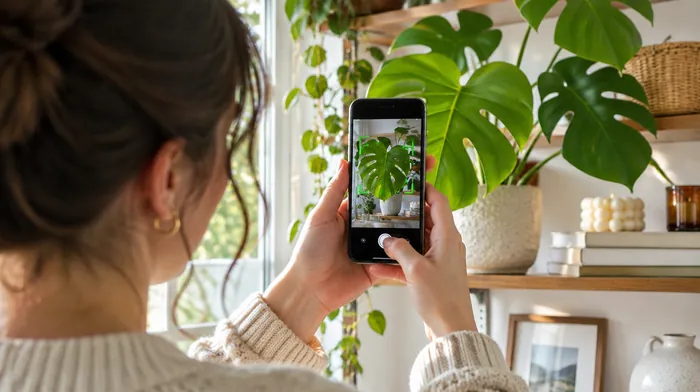
Snap a leaf, get a name and a schedule.
Tips that make it stick
Anchor it to your morning. Check the list with your first coffee, while the 8:00 email is fresh.
Group plants by spot. Plants in the same light often end up on similar rhythms, which makes watering rounds quicker.
Use pots with drainage. No schedule can save a plant sitting in water. Empty saucers after watering.
Change one thing at a time. When a plant struggles, adjust water, light or position one at a time so you know what helped.
Give it a few weeks. Plants respond slowly, so judge progress by weeks, not days.
Important
What a plant care app is NOT
Plant care apps are useful tools, but it's important to be clear about what they don't do, including LeafBell and every other app on this page:
✕ Not a guarantee
No app can promise a plant will survive or thrive. Pests, root problems, drafts, pot size and the plant's history all play a part.
✕ Not always right about identification
Photo identification is a best estimate. Unusual varieties, blurry photos or young plants can be misidentified, so double-check anything important.
✕ Not a botanist on site
Diagnoses, including LeafBell's AI-generated plant doctor, suggest likely causes from a photo and symptoms. They're a guide, not a guarantee.
✕ Not a vet or poison center
Pet-safety notes are general information. If a pet or child may have eaten a plant, contact your vet, doctor or poison control right away.
✕ Not a replacement for checking the soil
Schedules are a starting point. Your home's temperature, humidity and pot all change how fast soil dries.
✕ Not an overnight fix
A struggling plant takes weeks to recover. Expect gradual change from steady care, not a quick transformation.
✕ Not free forever
Most of these apps are subscriptions that renew automatically. Read the price, renewal terms and refund policy at checkout, and cancel anytime you need to.
✕ Not affiliated with each other
Planta, PictureThis, Greg, Blossom and Pl@ntNet are trademarks of their owners. None of them sponsors or endorses this page.
FAQ
Plant care app questions, answered
What is the best plant care app?
In our testing, LeafBell is the best plant care app for most houseplant owners because it builds a watering and feeding schedule for each plant adjusted for the light in its spot, shows what's due on a simple "Today" list, and reminds you every morning by email and calendar. Planta is a strong alternative if you want very detailed tracking inside a native app, and PictureThis is the pick if identification is your main goal.
How much does LeafBell cost?
LeafBell is a subscription. The 4-week plan is $9.99 for the first 4 weeks, then $29.99 every 4 weeks. The 12-week plan is $24.99 for the first 12 weeks, then $89.99 every 12 weeks. The 24-week plan is $39.99 for the first 24 weeks, then $179.99 every 24 weeks. Plans renew automatically unless you cancel, and LeafBell offers a 30-day money-back guarantee. Check the current price and terms at checkout before you subscribe.
Does LeafBell work on iPhone and Android?
Yes. It runs in your phone's browser, so there's nothing to download from an app store, and you can add it to your home screen so it opens like an app. Because it's a browser app, it doesn't send native push notifications; reminders arrive as a daily email at 8:00 local time and as calendar reminders you can add for each plant.
How does LeafBell identify plants?
You can snap a photo or type the plant's name. Photo identification is powered by Pl@ntNet. Like every identification tool, it can occasionally get a plant wrong, so check the result if something seems off.
Can a plant care app tell me if a plant is toxic to my pets?
LeafBell's care guides include pet-safety notes, and PictureThis and Blossom also offer toxicity information. Treat these as general guidance. If you think a pet has eaten a plant, contact your vet or an animal poison control line right away.
Will an app keep my plants alive?
An app can make good care much easier, but no app can guarantee a plant's survival. Light, drainage, pests, temperature and the plant's starting condition all matter. Use the schedule as a guide and check the soil before you water.
Is the plant doctor accurate?
LeafBell's plant doctor uses your photo and the symptoms you select to suggest likely causes and step-by-step fixes. The answers are AI-generated and meant as a guide, not a guarantee. For a valuable or very sick plant, a local nursery or plant specialist can help.
The bottom line
Every app here can help you take better care of your plants. Planta is great for detailed tracking, PictureThis for identifying almost anything, Greg for knowing exactly how much to water, and Blossom for care guides and edible plants. But if you want a schedule built around your plants and the light they actually live in, one simple "Today" list, and a reminder every morning at 8:00, LeafBell is our pick for the best plant care app. Start with its 60-second quiz.